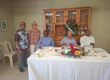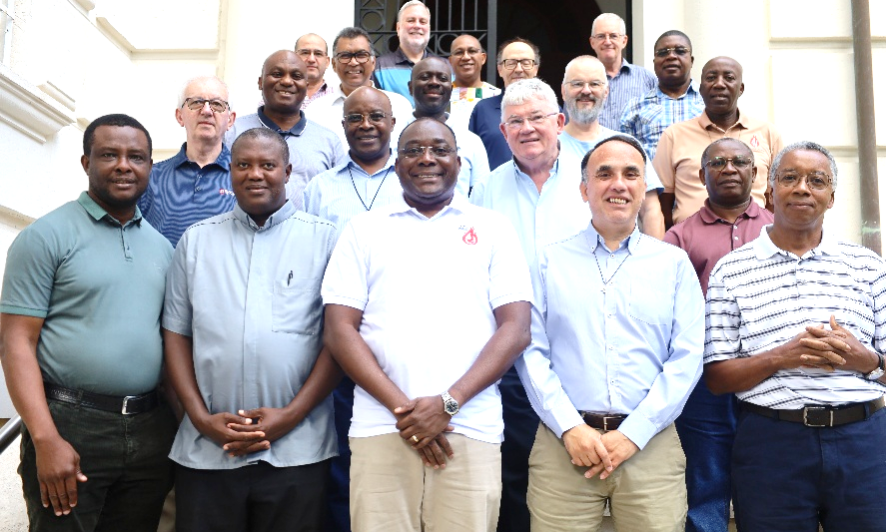
From 16 to 26 September, six newly appointed Spiritan Superiors convened with the General Council for a time of fraternal exchange, formation, and shared discernment.
This year, we welcomed a smaller number of new Superiors, as many had already participated in one of the two preceding meetings —eighteen in 2023 and twelve in 2024. This was due to the necessary alignment of the circumscriptions’ Chapters and the election of Superiors with the timeline of the General Chapter.
The new superiors were Frs. Brendan Carr (Ireland), Callistus Offor (Nederland), Hugo Norberto Mendes Ventura (Portugal), João Baptista Barros (Cape Verde), John Fogarty (USA) and Michael Gomes (Gambia).
The listed Circumscriptions span three different continents: Africa (Cape Verde, Gambia), Europe (Ireland, Nederland, Portugal), and North America (USA) demonstrating the global dimension of our Spiritan mission. It also shows that Spiritans are living and working in very diverse social, economic, cultural and political situations.
Two superiors were in their late 40s, one early 50s, one in his early 60s and two in their early 70s. So it was a group of dynamic and motivated Superiors for the demanding mission of leadership and the animation of their circumscriptions.
The meeting is a very important annual meeting for the members of the General Council and has three main goals: first of all, it gives the General Council an opportunity to get a sense of the challenges that our Spiritan leaders around the world are facing; second, it gives our new superiors a sense of the various services available to them in the Generalate and the various ways in which we might assist them in carrying out their ministry; third, it is an opportunity for the members of the General Council and the new superiors to work together towards a common understanding and a common vision of what it means to be a Spiritan leader in the world today which is vital for a decentralised organization.
The opening liturgy, presided by Fr. Alain Mayama, the Superior General, emphasized servant leadership rooted in humility, love, and Gospel fidelity. Drawing inspiration from Pope Francis’ 2013 address and the readings from 1 Peter and John 13, Fr. Mayama invited the newly elected Superiors to imitate Christ, who came not to be served but to serve. A powerful symbol of this call was the washing of feet, incorporated into the Mass and carried out by Fr. Alain Mayama, assisted by Fr. Jude Nnorom and Fr. Marc Botzung, echoing the Spiritan founders’ legacy of humble service.
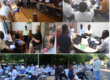
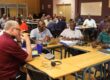
The meeting began with presentations by each new Superior, sharing the reality of his circumscription, followed by discussions. Members of the General Council then offered input on a wide range of topics essential to the life and mission of the Congregation: Leadership and Animation, functioning of the Unions of Circumscriptions, Confreres in irregular situations, Interreligious Dialogue (IRD), Canonical processes, intercultural communities, the Central Development Office and Mission Office, Justice, Peace and Integrity of Creation (JPIC), mission appointments, finances, Spiritan formation, safeguarding of minors and vulnerable adults, Spiritan education, Brothers and Lay Spiritan Associates.
The Superiors also had opportunity to visit and see different services at the Generalate.
Additional contributions were shared via Zoom: Fr. Chika Onyejiuwa presented CESS/KIBANDA, while Fr. Fabian Onyekachi Adindu spoke about mission as advocacy for human rights.
While the meeting was rich in reflection and formation, it also offered moments of grace beyond the formal sessions. The new superiors had the privilege of attending a Papal audience, exploring the spiritual and historical treasures of Rome, and spending a day in Assisi—the birthplace of Saint Francis. This pilgrimage echoed the footsteps of Fr. Libermann, who visited Assisi during his time in Rome in 1840, offering a contemplative link between past and present in the Spiritan journey of humble service and renewal.
Our new Superiors have dispersed; they have gone back to their circumscriptions, to their places of work. We hope that they now possess new vitality and new perspectives for the ministry they carry out on behalf of the Congregation.